The Pull Before the Haul
Dallas-area roads put vehicles in all kinds of situations. Some are simple. A car sits on the shoulder, accessible and ready to move. Our Rowlett towing team handles calls like that every day. Towing means connecting to a vehicle already in a towable position and moving it to where it needs to go. The right connection method depends on the vehicle type. Flatbeds carry the full vehicle on a flat deck, keeping all four wheels off the ground. Wheel-lift units raise either the front or rear axle for lighter, accessible vehicles. Heavy wreckers use boom and cradle systems for commercial loads. The dispatcher determines which unit fits before the truck leaves the yard.
The Equipment That Makes a Standard Tow Work
Flatbeds are the most versatile option for standard towing. They work for all-wheel-drive vehicles, low-clearance cars, and any vehicle with significant front-end or undercarriage damage. Wheel-lift units are faster to deploy and suited for lighter vehicles with no drivetrain damage. Heavy wreckers handle semis, buses, and large loads on accessible ground.
What a Car on a Flat Surface Tells the Operator
A car on an accessible, stable surface is ready to tow. Our operator can approach, hook up, and transport without any extraction work. Position, weight, and drivetrain type still shape which equipment goes on scene. An accessible vehicle keeps the call within predictable parameters from the start.
When Winching Has to Come First
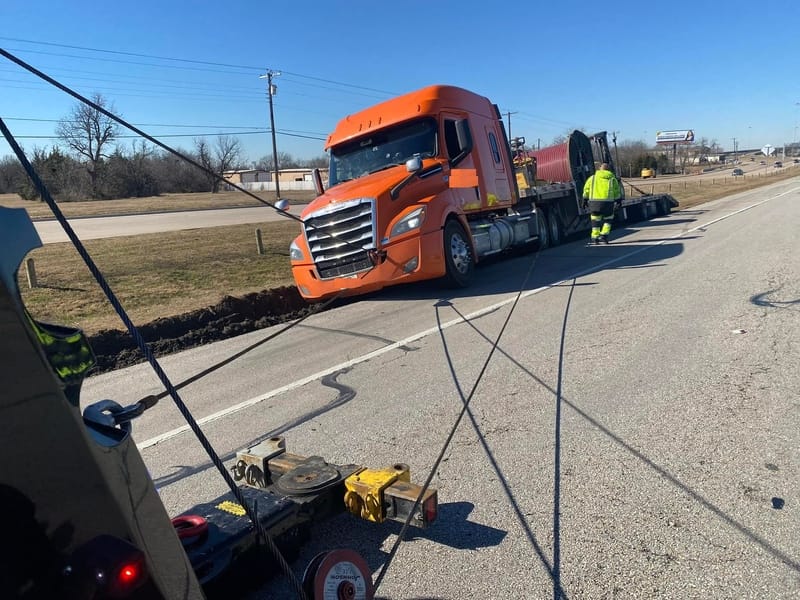
Winching is extraction, not transport. A vehicle in a ditch, off an embankment, or on soft terrain cannot be hooked up and moved directly. It has to be pulled back to an accessible position first.
The winch uses a motorized cable to apply controlled pulling force. Rigging determines the outcome. Snatch blocks redirect the line and multiply force, extension cables increase reach, and anchoring stabilizes the recovery truck. Rigging setup is what separates a clean extraction from a damaging one. Our Rowlett towing dispatchers ask the right questions before dispatch. Winching calls need different equipment than a straight tow.
Towing and Winching: When Each Applies
Here is how the two typically break down:
- Standard tow: vehicle is on a stable, accessible surface and ready for direct hook-up
- Flatbed tow: all-wheel-drive vehicles, low-clearance cars, and vehicles with significant damage
- Heavy wrecker tow: semis, buses, and commercial loads on accessible ground
- Winching: vehicle is off-road, in a ditch, or in a position that blocks a straight hook-up
- Winching before towing: the vehicle must be extracted to a towable position first
- A Rowlett towing call can require one, the other, or both depending on where the vehicle ended up
CTR Towing Service: Rowlett Towing With Three Generations Behind It
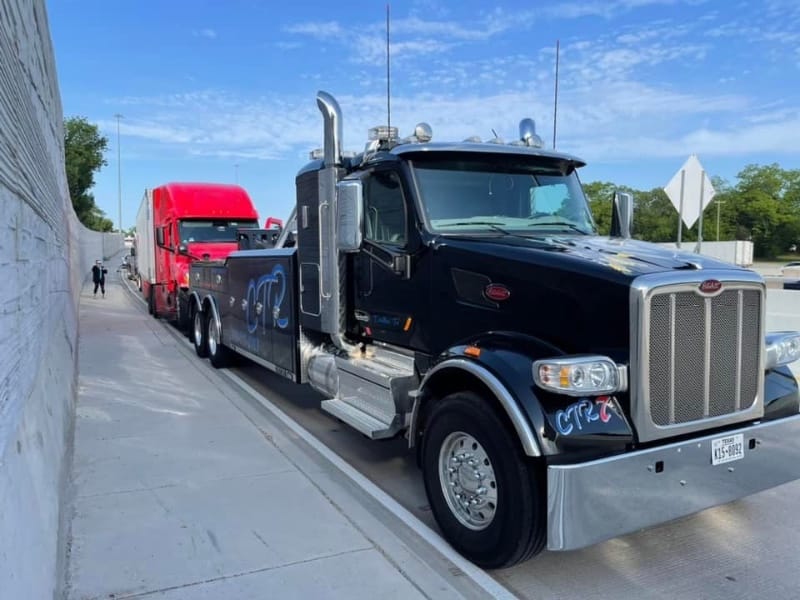
CTR Towing Service is a family-owned operation built on over 75 years of combined experience in the Dallas area. Founded by Kyle Chron and rooted in three generations of towing expertise, the team brings real knowledge to every call. Integrity, reliability, and a genuine connection to the Dallas community have defined CTR from the start. Every Rowlett towing call gets a crew that treats your vehicle as they would their own.
CTR has the fleet and training to handle everything from standard flatbeds to off-road winching and recovery. When a Rowlett towing call comes in, the dispatcher asks the right questions and sends the right unit. Low turnover on the CTR team means the same Rowlett towing operators on every job, call after call.
FAQ
What is a snatch block and how does it change a winching recovery?
A snatch block is a pulley that attaches to a fixed anchor point and redirects the winch cable. Running the line through a snatch block changes the pull angle and can double the effective pulling force without increasing cable tension beyond safe limits. It is a standard part of rigging on off-road and ditch recoveries where a straight-line pull is not possible.
Can any tow truck perform a winching recovery?
Not all tow trucks are set up for recovery winching. Standard flatbeds and wheel-lift units are designed for transport, not extraction. Operators who handle winching calls carry recovery-grade winches, extension lines, snatch blocks, and anchoring equipment. Sending a transport unit to a recovery call without the right rigging equipment wastes time and may not resolve the situation at all.
How do I know if my vehicle needs winching or just a tow?
If your vehicle is on a paved, flat, accessible surface, it most likely needs a tow. If it has left the roadway, gone into a ditch, rolled, or sunk into soft ground, it needs extraction first. The towing company’s dispatcher will ask about the vehicle’s position to make this determination before sending a unit. Describing what you can see around the vehicle helps that assessment.
What does rigging mean in the context of a vehicle recovery?
Rigging refers to the configuration of cables, blocks, straps, and anchors used to connect the winch to the stuck vehicle and direct the pulling force. A rigging plan accounts for the vehicle’s position, the terrain, the load weight, and what anchor points are available. The rigging setup is what makes a recovery safe and controlled rather than damaging or dangerous.
What is the difference between a flatbed and a wheel-lift tow?
A flatbed loads the entire vehicle onto a flat platform, keeping all four wheels off the ground during transport. A wheel-lift raises either the front or rear axle, leaving the other set of wheels rolling on the road. Flatbeds are the safer option for all-wheel-drive vehicles, cars with drivetrain damage, and any vehicle where partial lifting could cause additional damage.
How long does a winching recovery take compared to a standard tow?
A standard tow is typically faster because the vehicle is already in position to hook up. Winching adds time for scene assessment, rigging setup, the pull itself, and repositioning the vehicle for transport. A straightforward ditch recovery might add 20 to 30 minutes over a standard tow. Complex terrain, soft ground, or a rolled vehicle can extend that significantly depending on conditions.